The Yat-Kernel MLP in JAX/Flax NNX
#ml#kernels#interpretability#mlp#rkhs#yat#jax#flax#nnx#implementation#deep-learning
Part 2 of 6Attention Is a Kernel
The whole nonlinearity of this network is one expression, and it is not an activation function. The explainer argued that putting a finite, positive-definite kernel where the nonlinearity used to be turns an MLP into a kernel machine, with locality, attribution, geometry, capacity control, and a feature map you can write down. The point of doing it in Flax NNX is that each of those claims becomes an assert you can run: the Gram matrix is checked for positive-definiteness, the feature map for exactness to 1.8e-15, the response for boundedness, the gradient field for holes. Then the layer trains end to end on two moons. The dimensions are tiny throughout so the objects stay legible.
Prefer a notebook? Run the whole thing on Kaggle: the same code, block by block, with the math written out and every figure reproduced from a real run.
The unit
A Yat unit measures the input against a learned prototype with the kernel . A whole layer is a bank of these, and there is no activation function anywhere in it. In NNX the prototypes are the parameters; and are learned through a softplus so they stay admissible (, ).
import jax, jax.numpy as jnp
from flax import nnx


class YatLayer(nnx.Module):
    """A layer of Yat-kernel units. No activation function."""
    def __init__(self, d_in, n_units, *, rngs: nnx.Rngs, b0=0.5, eps0=0.5):
        self.W = nnx.Param(jax.random.normal(rngs.params(), (n_units, d_in)) * 0.7)
        self.log_b = nnx.Param(jnp.full((), jnp.log(jnp.expm1(b0))))     # softplus⁻¹(b₀)
        self.log_eps = nnx.Param(jnp.full((), jnp.log(jnp.expm1(eps0))))

    def __call__(self, x):                              # x: [..., d_in]
        b = jax.nn.softplus(self.log_b.value)
        eps = jax.nn.softplus(self.log_eps.value)
        dot = x @ self.W.value.T                        # [..., n_units]  = x·Wᵤ
        xn = jnp.sum(x ** 2, -1, keepdims=True)         # ‖x‖²
        wn = jnp.sum(self.W.value ** 2, -1)             # ‖Wᵤ‖²
        dist2 = xn + wn - 2.0 * dot                     # ‖x − Wᵤ‖²
        return (dot + b) ** 2 / (dist2 + eps)           # the kernel is the nonlinearity
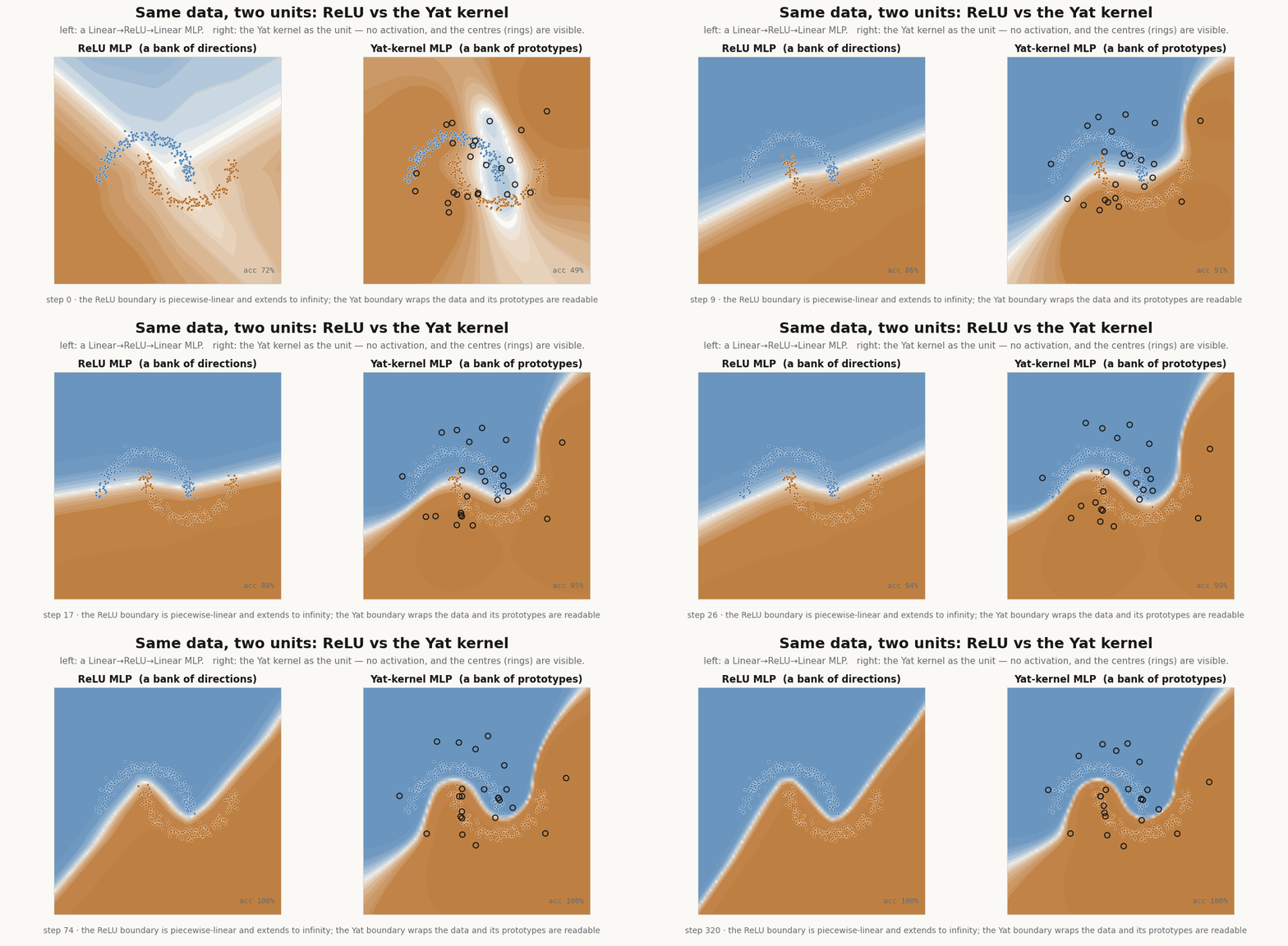
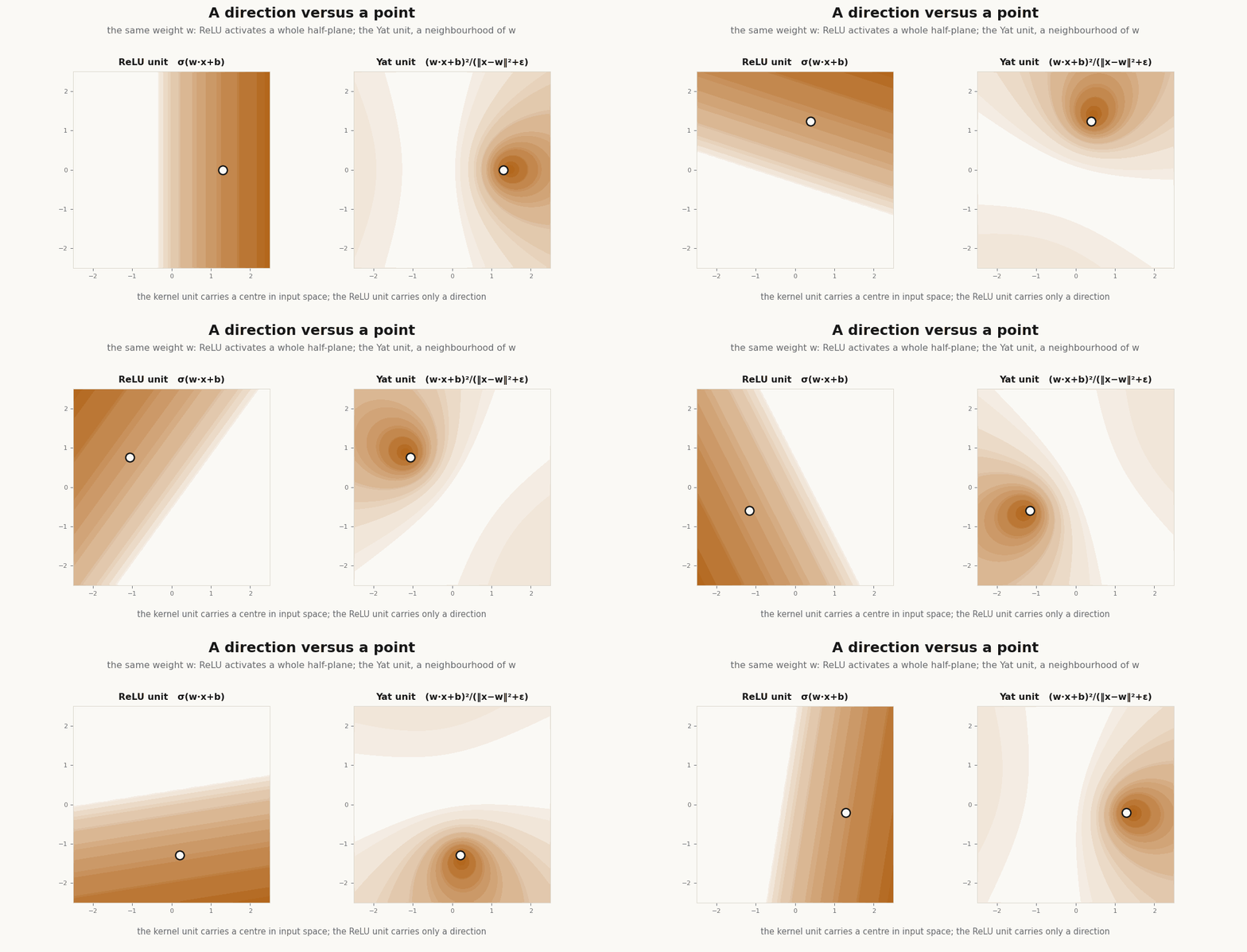
The prototype is a point in input space, not a direction. A ReLU unit fires on an entire half-plane; the Yat unit has a single localized peak at its center. Everything else in this post follows from that one change of type.
It is a kernel: positive definite and nonnegative
The two properties the explainer leans on are checkable in three lines. The Yat kernel is nonnegative (a square over a positive number) and positive definite (a Schur product of a polynomial and an inverse-multiquadric kernel), and these are independent facts, the unit has both.
def yat(a, b, bb=0.5, eps=0.5):                         # kernel matrix between two point sets
    cross = a @ b.T
    return (cross + bb) ** 2 / (jnp.sum(a**2, 1, keepdims=True) + jnp.sum(b**2, 1) - 2*cross + eps)

pts = jax.random.normal(jax.random.key(0), (16, 3))
G = yat(pts, pts)                                       # Gram matrix
print("min eigenvalue:", float(jnp.linalg.eigvalsh(0.5 * (G + G.T)).min()))  # ≈ 0.34 ≥ 0
print("all nonnegative:", bool((G >= 0).all()))         # True

assert jnp.linalg.eigvalsh(0.5 * (G + G.T)).min() >= -1e-8   # positive semi-definite (Mercer)
assert (G >= 0).all()                                        # nonnegative (convex weights)
Positive semidefiniteness is what gives the fixed kernel an RKHS; pointwise nonnegativity is what permits normalized convex weights. The admissible kernel uses and . The cited universality result requires the constant alignment term as well; at the even alignment factor loses odd functions on symmetric domains.
The finite feature map, exactly
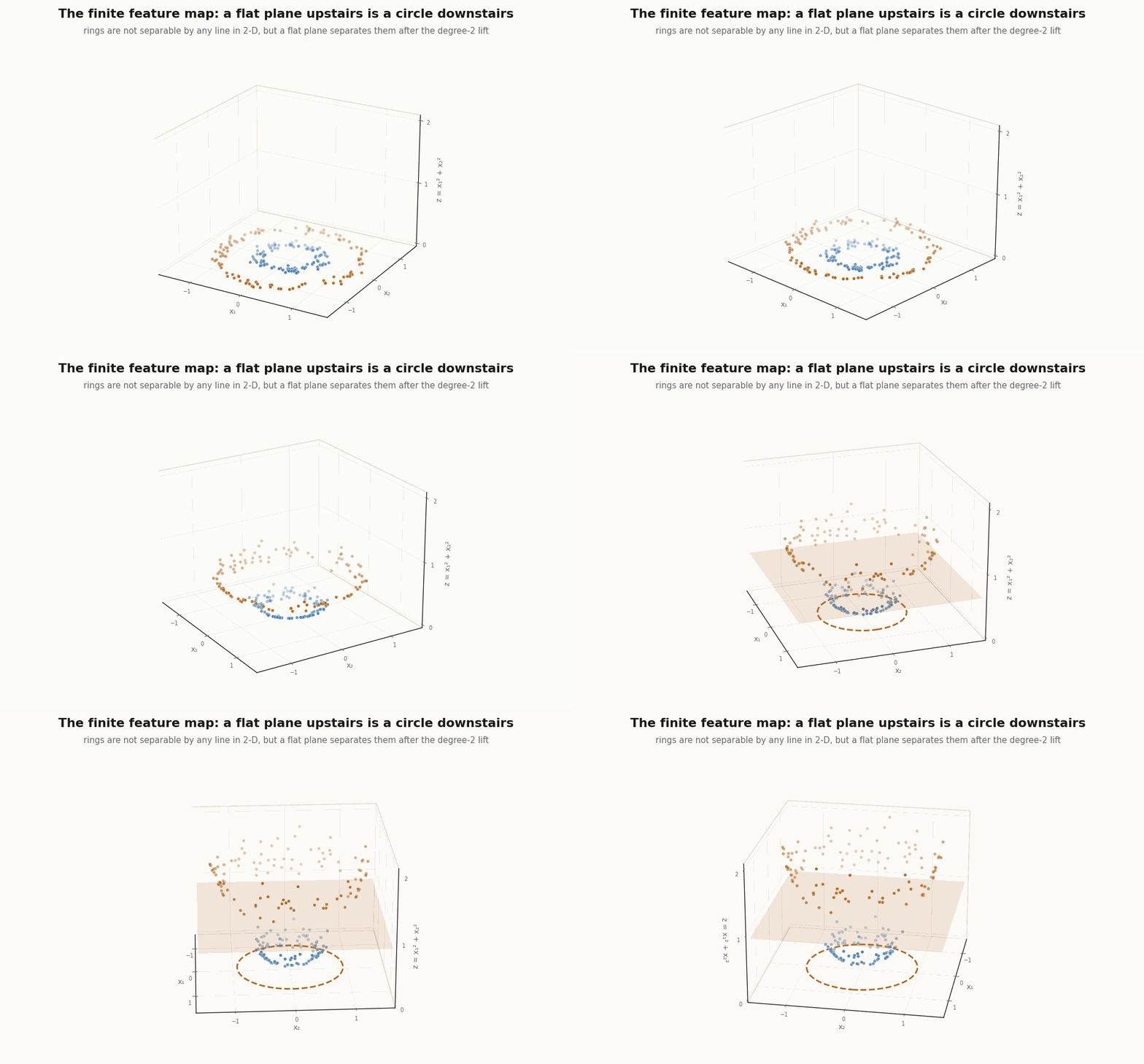
The word carrying the weight in “finite feature map” is finite. The Yat numerator is a degree-2 polynomial kernel, and a degree-2 polynomial kernel has an exact, finite-dimensional feature map, six numbers in two dimensions, in general. No infinite series to truncate, unlike the Gaussian RBF. Here it is, and here is the identity holding to machine precision:
s2 = jnp.sqrt(2.0)
def phi_x(x):                                           # feature map of the input,  R² → R⁶
    x1, x2 = x[..., 0], x[..., 1]
    return jnp.stack([x1**2, x2**2, s2*x1*x2, s2*x1, s2*x2, jnp.ones_like(x1)], -1)
def phi_W(W, b):                                        # matching map of the prototype
    W1, W2 = W[..., 0], W[..., 1]
    return jnp.stack([W1**2, W2**2, s2*W1*W2, s2*b*W1, s2*b*W2, b**2*jnp.ones_like(W1)], -1)

A = jax.random.normal(jax.random.key(1), (20, 2))
Wp = jax.random.normal(jax.random.key(2), (20, 2)); b0 = 0.7
lhs = (jnp.sum(A * Wp, -1) + b0) ** 2
rhs = jnp.sum(phi_x(A) * phi_W(Wp, b0), -1)
print("max |error|:", float(jnp.max(jnp.abs(lhs - rhs))))      # ≈ 1.8e-15

assert jnp.allclose(lhs, rhs, atol=1e-8)                # the feature map is exact, not approximate
A finite feature map means a flat separator in feature space, which is a curved boundary in input space, the kernel trick. Fit that flat plane on data that no line can split, and watch it work.
Train it, with no activation function
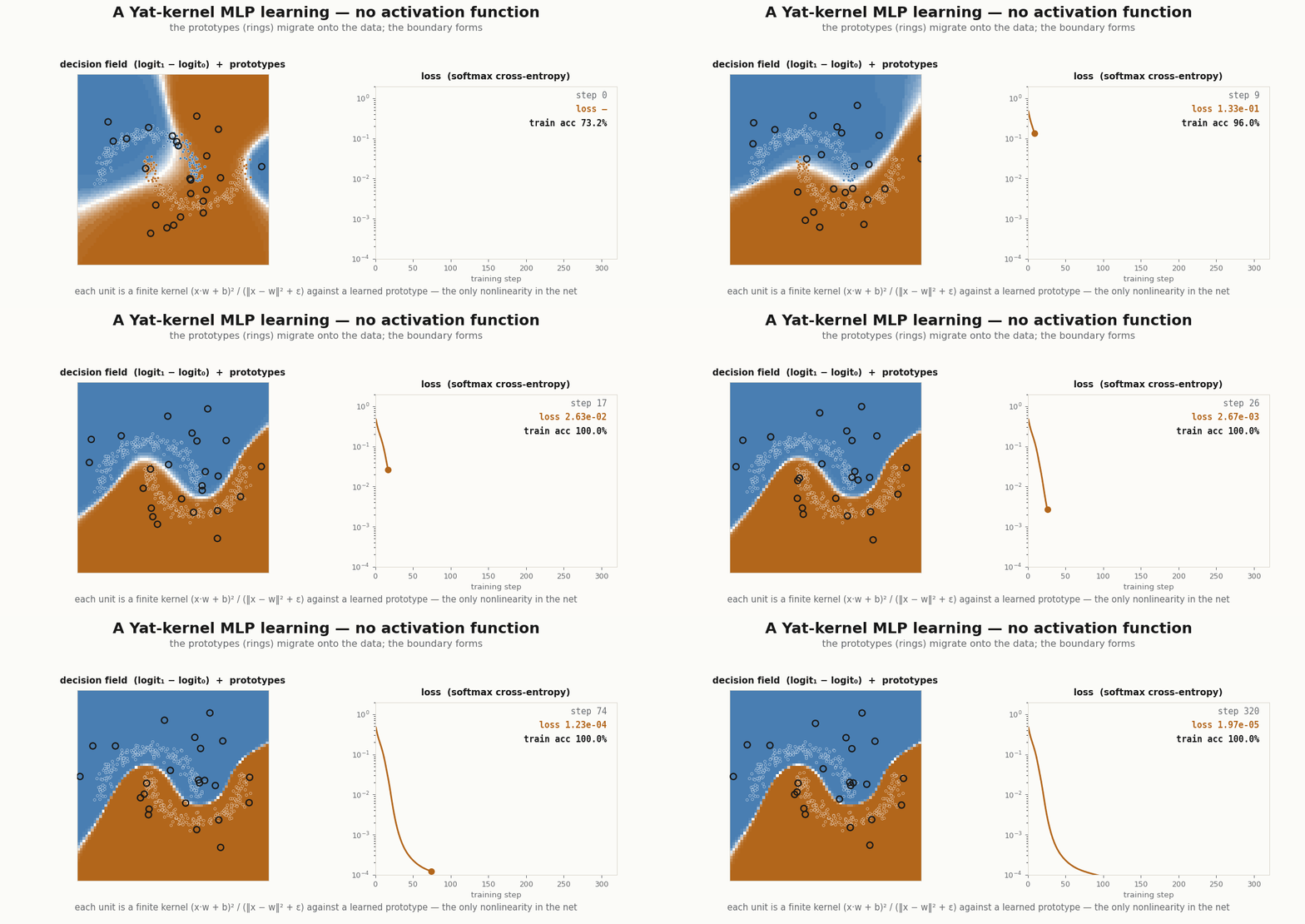
A YatMLP is just a YatLayer followed by a linear readout. It trains like any other NNX module, except the only nonlinearity in the network is the kernel.
import optax


class YatMLP(nnx.Module):
    def __init__(self, d_in, n_units, d_out, *, rngs: nnx.Rngs):
        self.yat = YatLayer(d_in, n_units, rngs=rngs)
        self.readout = nnx.Linear(n_units, d_out, use_bias=True, rngs=rngs)

    def __call__(self, x):
        return self.readout(self.yat(x))                # kernel activations → logits


model = YatMLP(d_in=2, n_units=24, d_out=2, rngs=nnx.Rngs(0))
optimizer = nnx.Optimizer(model, optax.adam(3e-2), wrt=nnx.Param)


@nnx.jit
def train_step(model, optimizer, X, y):
    def loss_fn(model):
        logits = model(X)
        return optax.softmax_cross_entropy_with_integer_labels(logits, y).mean()

    loss, grads = nnx.value_and_grad(loss_fn)(model)
    optimizer.update(model, grads)
    return loss


for step in range(320):                                  # X, y are two-moons (see the figure)
    loss = train_step(model, optimizer, X, y)
print("final loss:", float(loss))                        # ≈ 2e-5
print("train accuracy:", float((model(X).argmax(-1) == y).mean()))   # 1.0
print("learned b, ε:", float(jax.nn.softplus(model.yat.log_b.value)),
      float(jax.nn.softplus(model.yat.log_eps.value)))   # b → 1.02, ε → 0.25
It reaches the data, and the prototypes do the reaching: they start scattered and migrate onto the moons, while and adapt to the scale. At every frozen checkpoint the predictor is a finite expansion in sections of the Yat kernel family. Across checkpoints the centers and hyperparameters move, so training searches changing finite spans rather than solving one fixed RKHS problem.
Lazy loading: the layer fires a handful of units
Each unit is peaked at its center, but the exact kernel response is positive and therefore dense: every prototype contributes something. Retrieval becomes an approximation only after choosing a tolerance or top- rule and measuring the omitted response mass or prediction error. Response concentration can make that approximation useful; sparsity is not guaranteed by the formula.
layer = YatLayer(2, 64, rngs=nnx.Rngs(0))
Xb = jax.random.normal(jax.random.key(3), (200, 2))
act = layer(Xb)                                          # [200, 64] kernel activations
frac_yat = float(jnp.mean(act >= 0.18 * act.max(-1, keepdims=True)))

relu = jnp.maximum(Xb @ jax.random.normal(jax.random.key(4), (2, 64)), 0.0)
frac_relu = float(jnp.mean(relu > 0))
print(f"active fraction, Yat {frac_yat*100:.0f}%   ReLU {frac_relu*100:.0f}%")   # Yat 25%  ReLU 50%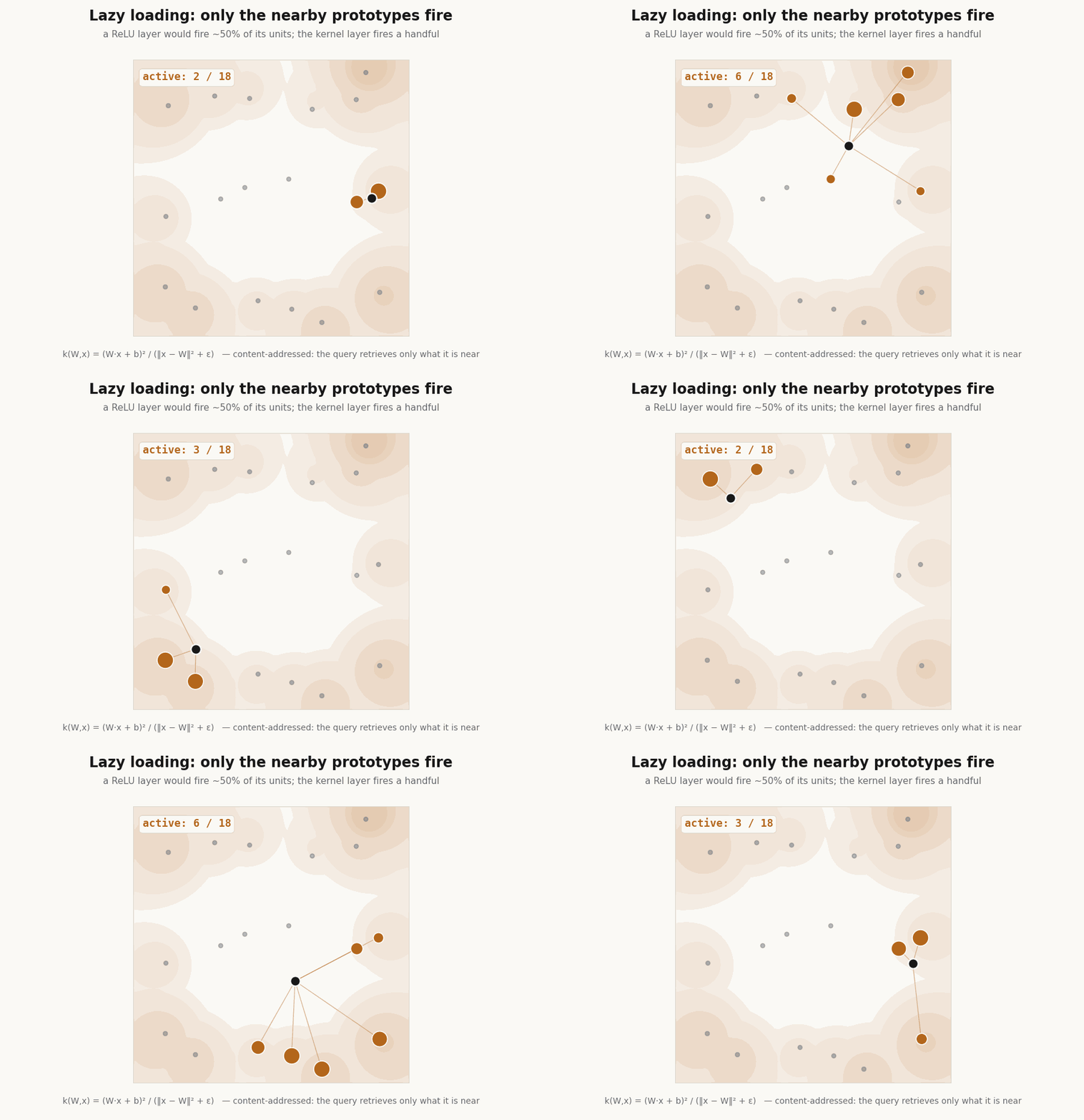
Bounded off the distribution
Drive a ReLU unit far from the data and it climbs without bound, a confident answer for an input it has never seen. The Yat unit stays bounded: its response far away is a fraction of its in-data peak, never an extrapolated cliff.
xs = jnp.linspace(-50, 50, 4001)
yat_1d  = (xs + 0.6) ** 2 / (xs ** 2 + 0.3)
relu_1d = jnp.maximum(xs + 0.6, 0.0)
print("sup |Yat| :", float(jnp.max(yat_1d)))    # 2.20, bounded over the whole range
print("sup  ReLU :", float(jnp.max(relu_1d)))   # 50.6, grows with the range

assert jnp.max(yat_1d) < 5.0                     # bounded no matter how far off-distribution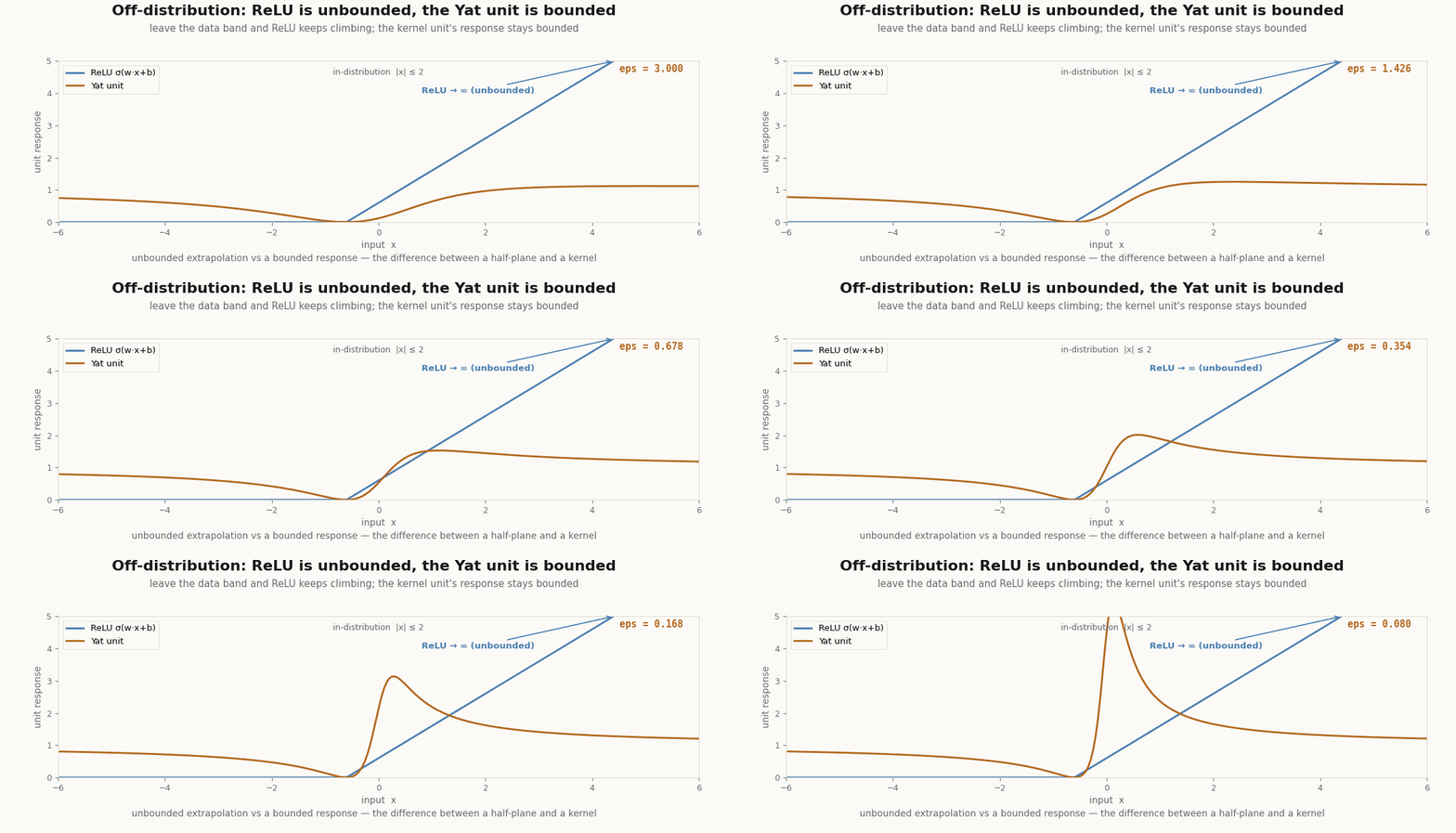
Capacity you can compute, and a force that never vanishes
The RKHS norm of a unit at its peak is the computable scalar , a real measure of how sharply it is tuned, and a direct target for regularization through . And because the kernel is smooth everywhere, the gradient that pulls a prototype toward its data never vanishes, there is no dead half-space, the way a saturated ReLU has.
W0 = jnp.array([1.0, 0.5])
print("capacity (‖W‖²+b)²/ε:", float((jnp.sum(W0**2) + 0.5) ** 2 / 0.25))   # 12.25

# the force on a prototype = −∇ of an objective that makes it a class detector
def k(P, X, b=0.5, eps=0.4):
    cross = X @ P
    return (cross + b) ** 2 / (jnp.sum(X**2, 1) + jnp.sum(P**2) - 2*cross + eps)
L = lambda P: k(P, XB).mean() - k(P, XA).mean()          # attract to A, repel from B
forces = jax.vmap(jax.grad(L))(jax.random.normal(jax.random.key(7), (50, 2)) * 1.5)
print("min ‖force‖ over 50 probes:", float(jnp.min(jnp.linalg.norm(forces, axis=1))))  # 0.32 > 0

assert jnp.min(jnp.linalg.norm(forces, axis=1)) > 1e-4   # force everywhere, no dead zone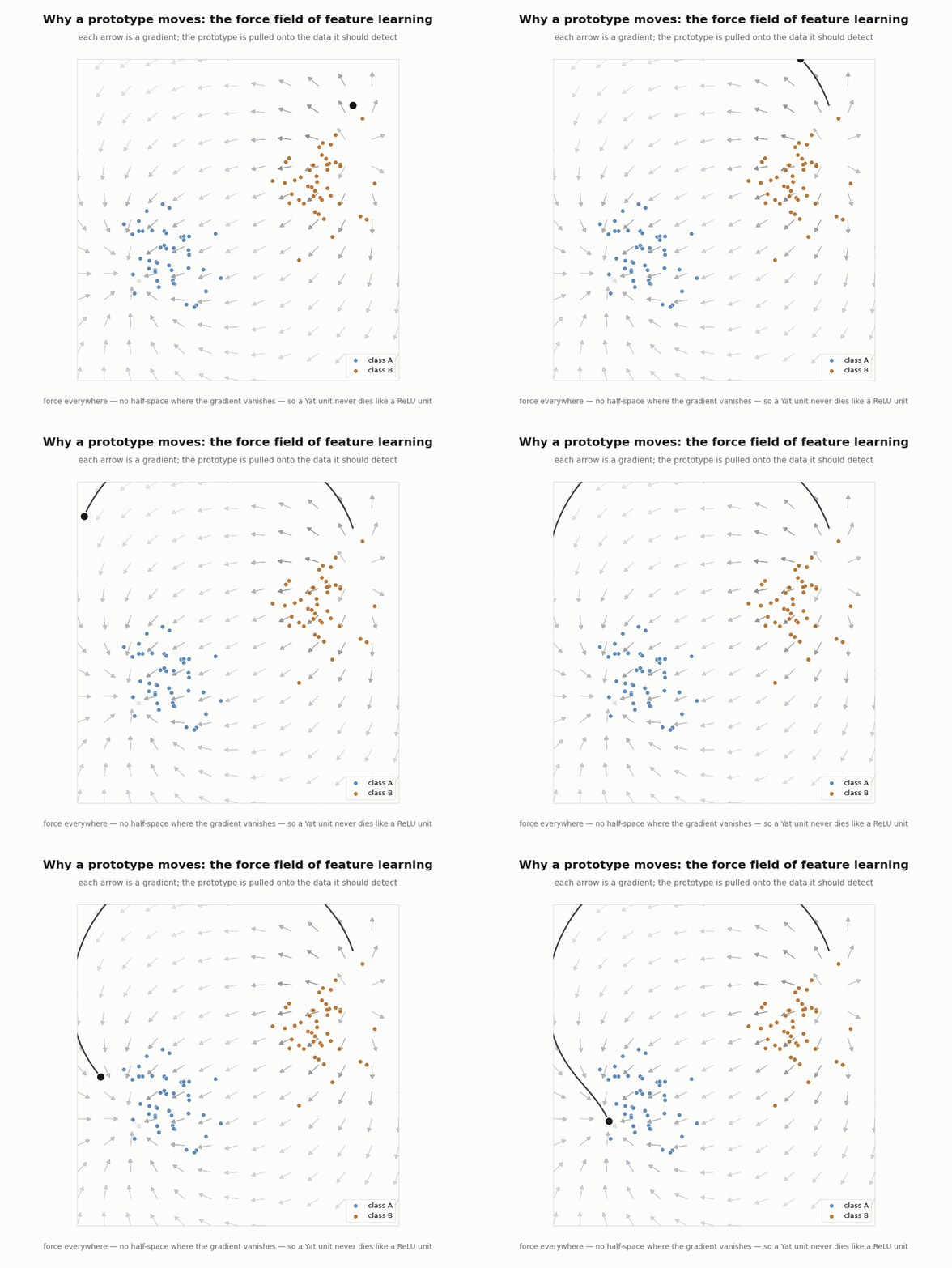
Fashion-MNIST: the center is an image
The same layer works on flattened images without changing its arithmetic. Seed each row of W from a training image, add a linear readout, and train the module with the ordinary NNX loop above:
Winit = X[np.random.RandomState(1).permutation(len(X))[:48]]
model = YatMLP(784, 48, 10, rngs=nnx.Rngs(0), Winit=Winit)
opt = nnx.Optimizer(model, optax.adam(4e-3), wrt=nnx.Param)
Because model.yat.W.value has shape [48, 784], the centers render directly as 48 images. With a linear readout, the contribution of center to class is exactly act[u] * readout.kernel[u, c]; normalizing raw activations is useful for display but does not turn signed logit terms into causal percentages.
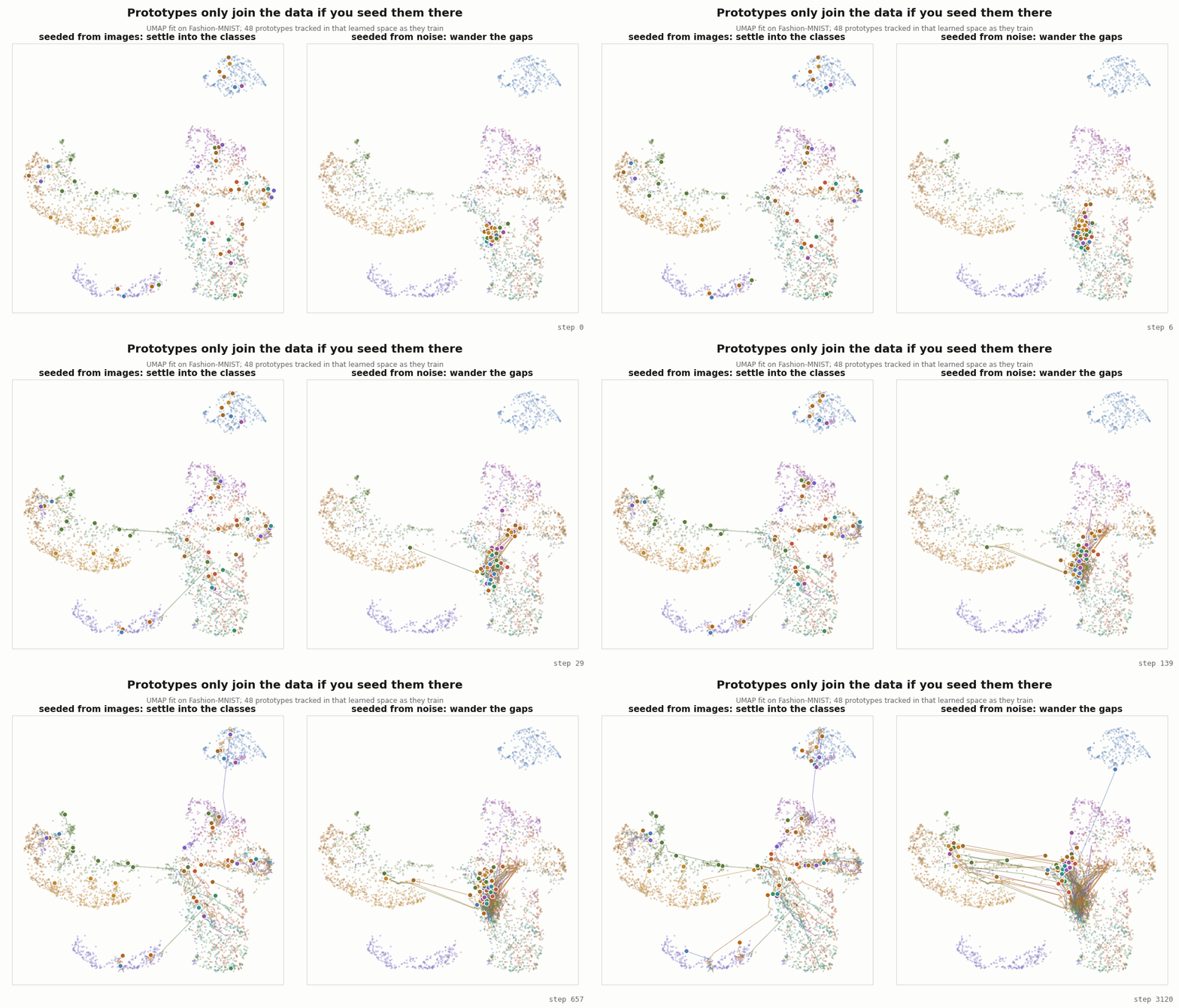
The stronger control changes only the initialization. A bank seeded from real images remains garment-like; a bank seeded from noise matched to the per-pixel mean and variance reaches similar accuracy while remaining noise. The kernel makes an input-space picture possible. Data seeding is what puts the center on the image manifold.
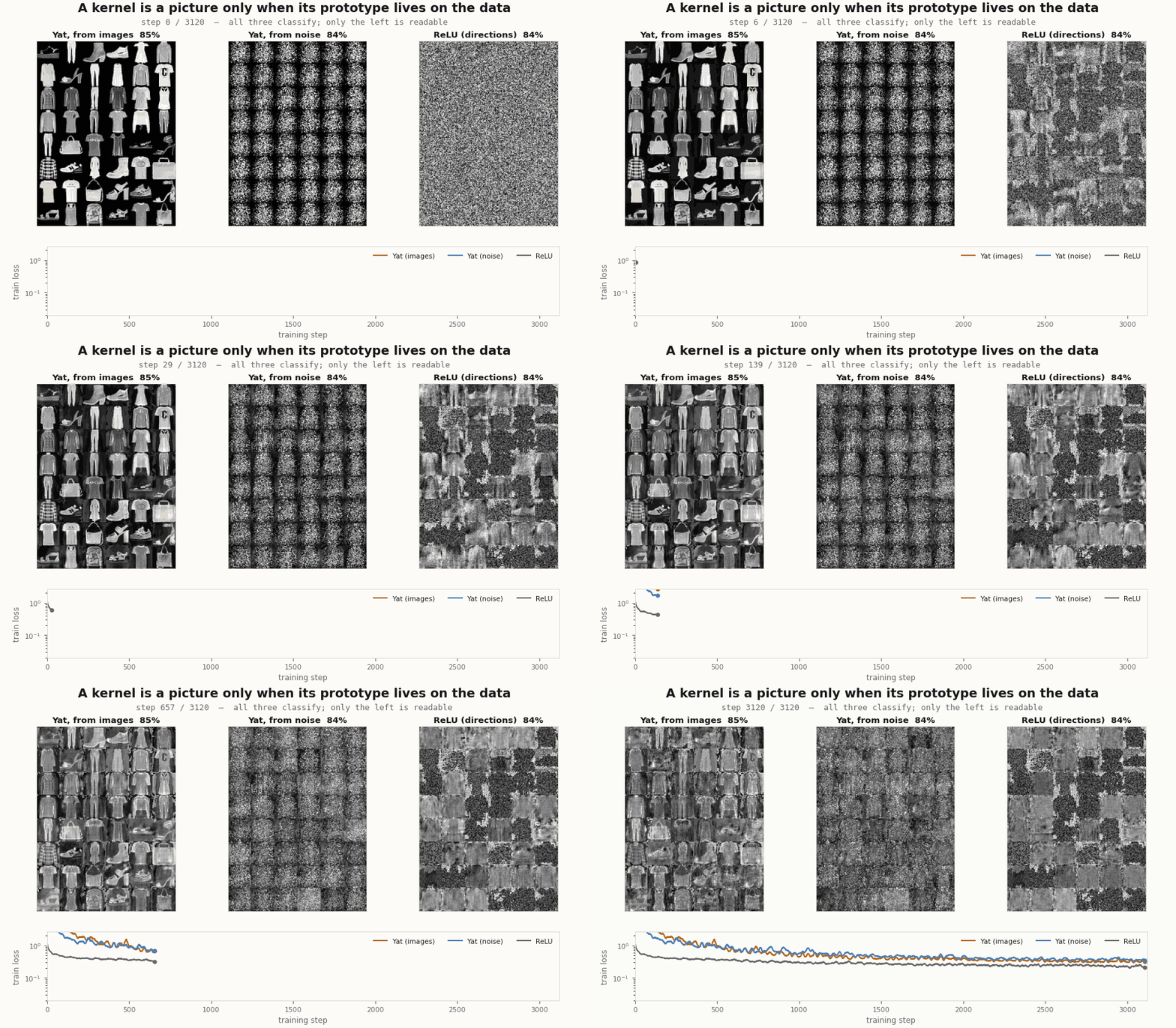
Projecting snapshots through a UMAP fitted once on the data makes the distinction geometric. Image-seeded centers move inside class neighborhoods; noise-seeded centers occupy gaps between them. The projection is descriptive, so nearest-data distances in the original 784-dimensional space remain the primary check.
Boundary of the result
This teaching implementation is not evidence of a drop-in transformer FFN advantage. The distance term costs more memory traffic than one GEMM, the canonical block is rather than an unchanged stack of kernel sections, and visible prototypes depend on initialization as well as parameterization. What the code establishes is narrower: a finite learned-center kernel layer with numerically checked PSD structure, exact layer-local arithmetic, measurable response concentration, and centers whose relation to the data manifold can be tested directly.
The Yat kernel and its universality are from Bouhsine (2026). Flax NNX Module API; the representer theorem from Schölkopf et al. (2001); the Neural Tangent Kernel from Jacot et al. (2018); random features from Rahimi & Recht (2007). The conceptual companion is What a Finite Kernel Buys an MLP.
Cite as
Bouhsine, T. (). The Yat-Kernel MLP in JAX/Flax NNX. Records of the !mmortal Data Scientist. https://tahabouhsine.com/blog/yat-mlp-jax-flax-nnx/
BibTeX
@misc{bouhsine2026yatmlpjaxflaxnnx,
  author       = {Bouhsine, Taha},
  title        = {The Yat-Kernel MLP in JAX/Flax NNX},
  year         = {2026},
  month        = {jun},
  howpublished = {\url{https://tahabouhsine.com/blog/yat-mlp-jax-flax-nnx/}},
  note         = {Blog post, Records of the !mmortal Data Scientist}
}References
- (1909). Functions of Positive and Negative Type, and their Connection with the Theory of Integral Equations. Philosophical Transactions of the Royal Society A 209, 415–446.
- (2001). A Generalized Representer Theorem. COLT 2001, 416–426.
- (2007). Random Features for Large-Scale Kernel Machines. NeurIPS 2007.
- (2018). Neural Tangent Kernel: Convergence and Generalization in Neural Networks. NeurIPS 2018.arXiv:1806.07572
- (2026). A Universal Reproducing Kernel Hilbert Space from Polynomial Alignment and IMQ Distance. arXiv:2605.03262