Latent on the Spectrum, in JAX
#ml#representation-learning#neural-collapse#simplex-etf#latent-space#spectral-embedding#kernel-methods#jax#implementation
Part 4 of 6Geometry of Representations
- 1What Activations Do to Geometry
- 2Untangling the Moons: A Visual History of Contrastive Learning
- 3What Makes a Good Latent Space? The Welch Bound and the Simplex
- 4Latent on the Spectrum: Why Cats Sit Closer to Dogs Than to Carsthis post's explainer
- 5The Three States of Information
- 6Distillation Is a Geometry, Not an Answer Key
Almost everything here is one function call, jnp.linalg.eigh, applied to a matrix the size of your label set. Diagonalise a label-similarity kernel, keep its strongest modes, and the codebook’s geometry is already decided: that is the explainer’s claim, and the code is short enough to check it in an afternoon. What follows is the classical-MDS embedding with its square-root scaling done right, the flat→simplex and graded→horseshoe morph, kernel-target alignment, and the split of a trained representation into a prototype frame and an information tail.
Prefer a notebook? Run the whole thing on Kaggle: the same code, block by block, with the math written out and every figure reproduced from a real run.
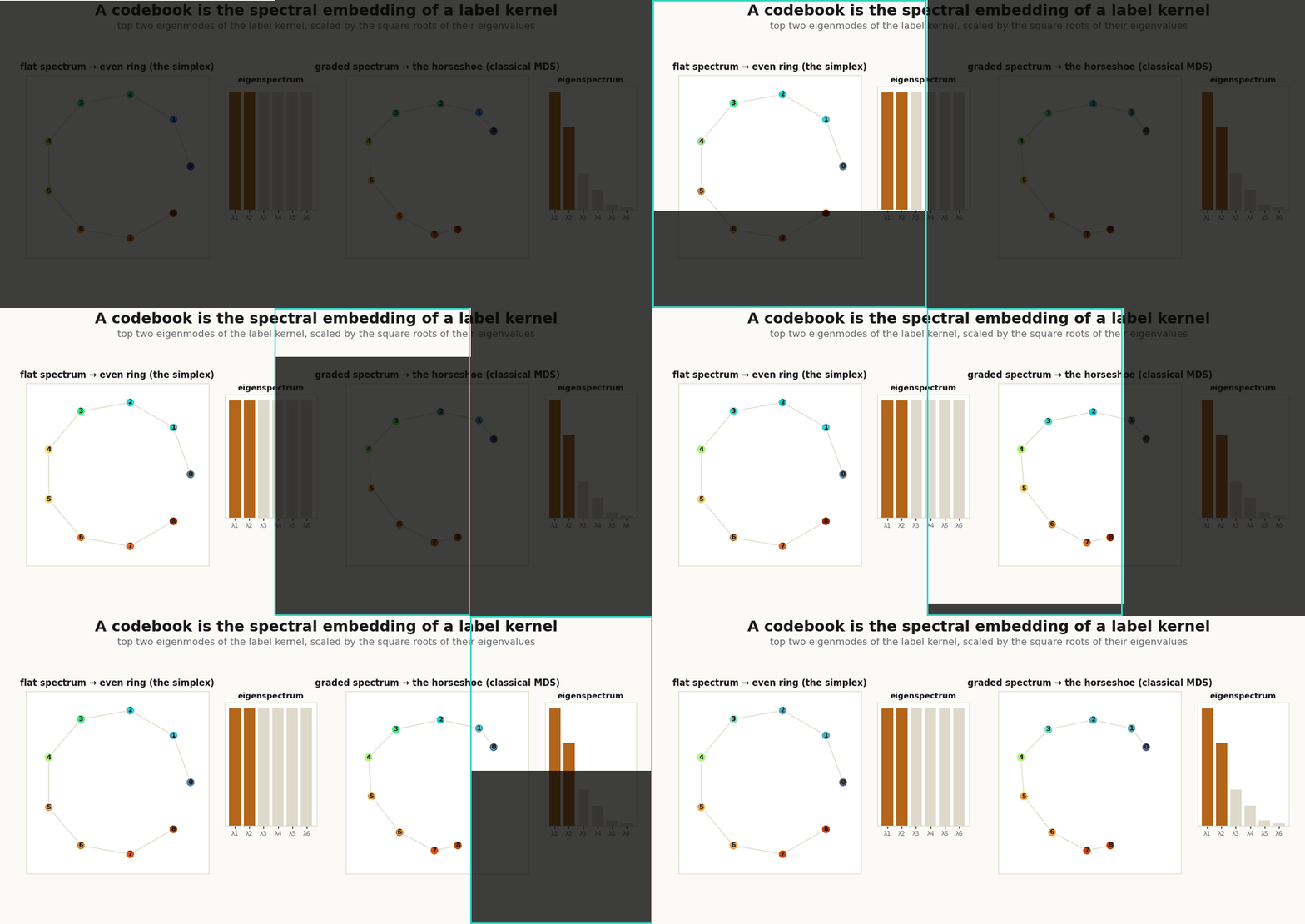
jnp.linalg.eigh. The staged reveal connects the target kernel, its eigenspectrum, and the resulting coordinates.Everything here is plain JAX. The objects are tiny (a C × C label kernel, a handful of features) so the linear algebra is legible.
A codebook is the spectral embedding of a kernel
How does a target similarity S between classes become actual coordinates? You read them off the spectrum. Ignoring the unit-norm step for a moment, the best rank-d Gram is , and a coordinate matrix that realises it is : the top-d eigenvectors scaled by the square roots of their eigenvalues. If we want cosine codes, we normalise afterward.
import jax
import jax.numpy as jnp


def spectral_codebook(S, d):
    """S: (C, C) symmetric label kernel -> C unit-norm codes in R^d."""
    w, V = jnp.linalg.eigh(S)                 # ascending eigenpairs
    w, V = w[::-1], V[:, ::-1]                # to descending
    coords = V[:, :d] * jnp.sqrt(jnp.clip(w[:d], 0.0, None))   # Lambda_d^{1/2} U_d^T : rows are codes
    return coords / (jnp.linalg.norm(coords, axis=1, keepdims=True) + 1e-9)
That single eigendecomposition is classical multidimensional scaling, the spectral fact behind kernel PCA and Laplacian eigenmaps. The reconstruction error of the rank-d codebook is exactly the tail of the spectrum:
def gram_error(S, d):
    w, V = jnp.linalg.eigh(S)
    w, V = jnp.clip(w[::-1], 0.0, None), V[:, ::-1]
    Shat = (V[:, :d] * w[:d]) @ V[:, :d].T
    return jnp.linalg.norm(Shat - S) / jnp.linalg.norm(S)     # falls as the kept modes capture more of S
The spectrum decides the geometry
Three label kernels, three spectra, three shapes. The structureless kernel is flat and gives the even simplex; a block kernel is two-peaked and gives clusters; a graded kernel (similarity falling off with class distance) is the horseshoe of Diaconis, Goel & Holmes (2008).
C = 9
i = jnp.arange(C)

flat   = jnp.eye(C) - jnp.ones((C, C)) / C                       # structureless: the simplex
blocks = (i[:, None] // 3 == i[None, :] // 3).astype(jnp.float32)  # 3 superclasses of 3: clusters
graded = jnp.exp(-((i[:, None] - i[None, :]) / 2.2) ** 2)        # falls with class distance: the horseshoe

for name, S in [("flat", flat), ("blocks", blocks - blocks.mean()), ("graded", graded - graded.mean())]:
    codes = spectral_codebook(S, d=2)
    w = jnp.clip(jnp.linalg.eigh(S)[0][::-1], 0.0, None)
    print(name, "top-3 spectrum:", jnp.round(w[:3] / (w[0] + 1e-9), 2))
# flat   -> [1.  1.  1. ]  (no preferred direction -> even ring)
# blocks -> [1.  1.  0. ]  (two dominant modes, then nothing -> clusters)
# graded -> [1.  0.7 0.3]  (a smooth tail -> a curved 1-D manifold, the horseshoe)
The hero figure above is exactly this spectral_codebook(S, 2) evaluated on the flat and graded kernels, with the two embeddings orthogonally aligned so the contrast is legible.
Kernel-target alignment
The reason this works is an old idea that has aged well: the ideal embedding kernel is the label kernel (Cristianini et al., 2002). The match between them is one cosine between two Gram matrices:
def alignment(A, B):
    return jnp.sum(A * B) / (jnp.linalg.norm(A) * jnp.linalg.norm(B) + 1e-9)


codes = spectral_codebook(graded - graded.mean(), d=2)
gram = codes @ codes.T                                   # the codebook's own similarity
print(alignment(gram, graded - graded.mean()))           # high: the 2-D code already captures the kernel
Raise d and the alignment climbs toward 1 as the codebook is allowed to reproduce more of the kernel’s spectrum. The figure below shows that budget directly: for a few values of d it rebuilds the rank-d Gram from the top eigenmodes and lays the reconstruction next to the target kernel, with alignment and gram_error charted across every budget.
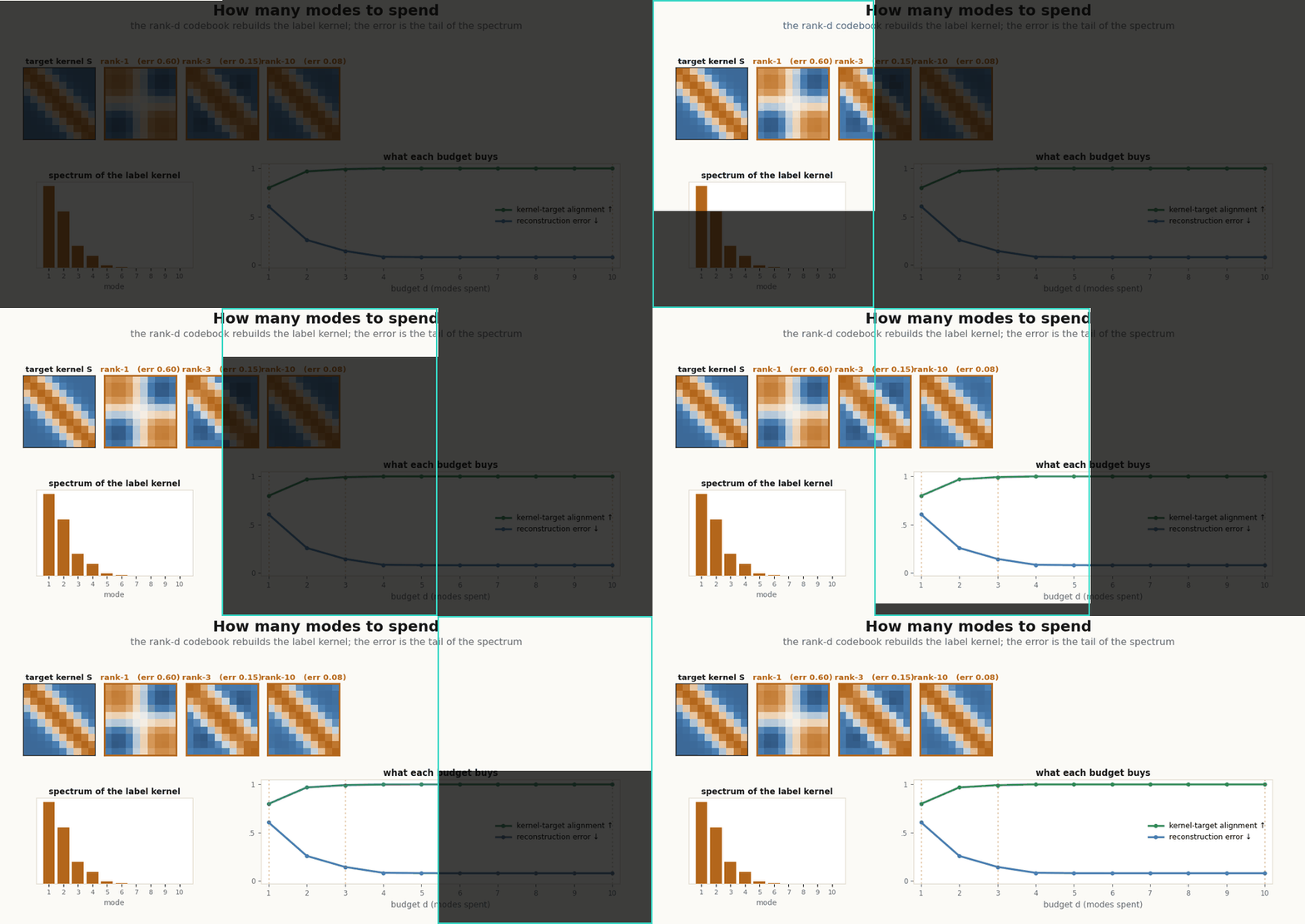
d Gram matrix (the top d eigenmodes of the label kernel) is laid beside the target for d = 1, 3, and 10. As d grows the reconstruction sharpens back into the kernel; the curves show alignment climbing toward 1 and gram_error falling across every budget. The error you carry is the tail of the spectrum you chose not to spend on, term for term. The animation adds reconstruction budgets in rank order before exposing the full error curves.A handful of modes already recover most of a graded kernel, which is the whole reason a low-dimensional codebook works: the kernel’s mass lives in its top eigenvalues, and the rest is a tail you can drop.
The prototype frame and the information spectrum
What does a trained representation keep of all this? Switch objects, from the target label kernel to a feature matrix, and split it into between-class and within-class covariance. The between-class part has rank at most C-1 and spans the prototypes: it is the separation channel, the codebook. The within-class part is everything else: the gradations the codebook does not carry, the information.
def class_covariances(Z, y, C):
    mu = jnp.stack([Z[y == c].mean(0) for c in range(C)])
    g, N = Z.mean(0), Z.shape[0]
    SB = sum((y == c).sum() * jnp.outer(mu[c] - g, mu[c] - g) for c in range(C)) / N
    SW = jnp.mean(jax.vmap(lambda z, c: jnp.outer(z - mu[c], z - mu[c]))(Z, y), 0)
    return SB, SW


SB, SW = class_covariances(Z, y, C)
eig_B = jnp.clip(jnp.linalg.eigvalsh(SB)[::-1], 0.0, None)   # <= C-1 nonzero: the prototype frame
eig_W = jnp.clip(jnp.linalg.eigvalsh(SW)[::-1], 0.0, None)   # the information tail
print("nonzero prototype modes:", int((eig_B > 1e-6 * eig_B[0]).sum()), "  (C-1 =", C - 1, ")")
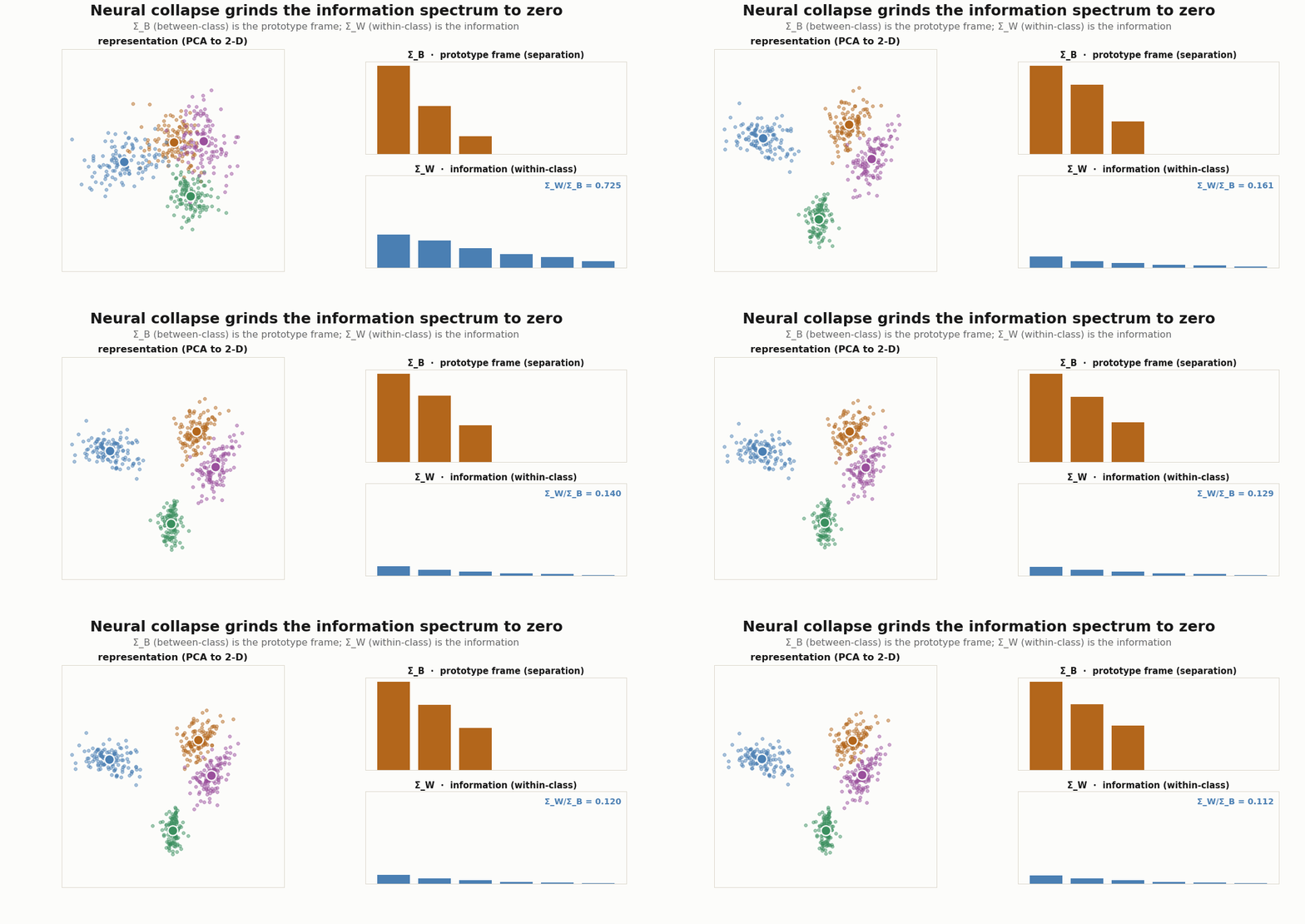
The split is clean only when the between-class variance dominates, as it does near neural collapse; with large within-class variance the two regimes overlap. The figure below trains a small encoder with cross-entropy and watches it happen: sharpens into a C-1-mode simplex frame while the spectrum is ground toward zero (Papyan, Han & Donoho, 2020).
Dark knowledge is the coefficients
The explainer’s last move: the information that survives lives between the prototypes, as the soft mixture a feature makes over them, the dark knowledge a teacher distils (Hinton et al., 2015). In this frame view it is a coefficient vector, a soft assignment over the prototype frame:
def soft_assignment(z, prototypes, tau=0.1):
    """z: (..., d) feature; prototypes: (C, d). Returns coefficients over the codebook."""
    return jax.nn.softmax((z @ prototypes.T) / tau, axis=-1)


a = soft_assignment(z, mu)        # e.g. [0.70, 0.27, 0.02, 0.01]: "mostly cat, a bit dog"
Sharpen tau → 0 and the vector collapses to one-hot, erasing the relation between classes, which is the effect label smoothing and a low temperature have. The information is the off-one-hot mass. On a graded codebook the point is visible in the geometry: a feature near class k lends its mass to k’s neighbours on the horseshoe, so the assignment encodes which classes are similar, and cooling the temperature burns that structure away.
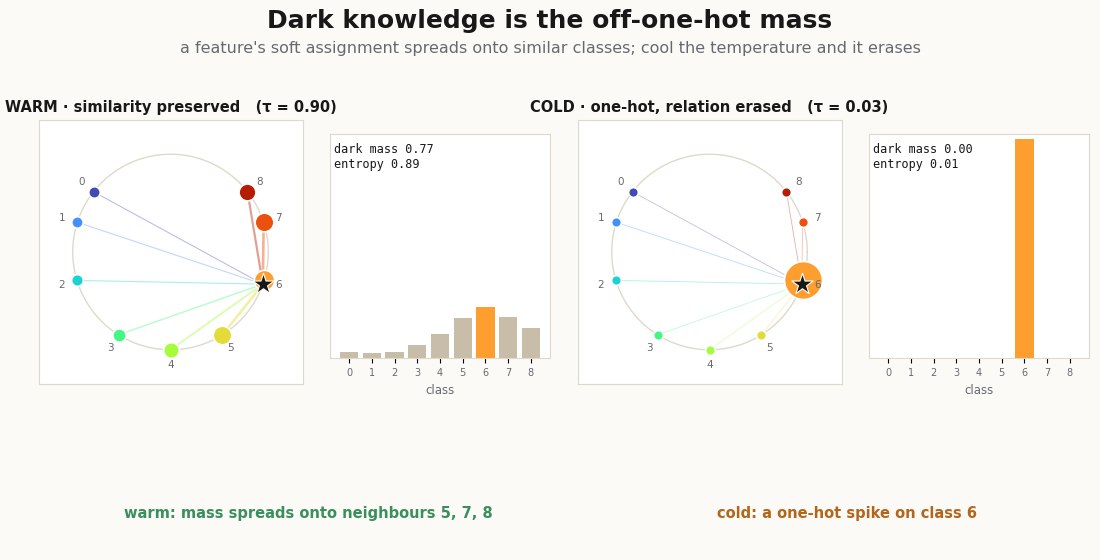
soft_assignment is shown as marker sizes (left of each pair) and bars (right). Warm (τ = 0.90): the mass spreads onto the geometric neighbours (5, 7, 8), encoding class similarity, with dark-knowledge mass 0.77 and high entropy. Cold (τ = 0.03): it collapses to a one-hot spike on class 6, the relation between classes erased and the dark-knowledge mass at 0.Rendering the figures
All four figures are generated with Python, JAX, and matplotlib: the linear algebra in JAX, the drawing in matplotlib. Three are static contrasts (a kernel dial, a budget, a temperature are knobs, not processes); only neural collapse is a real training run, so only it animates.
The codebook figure computes spectral_codebook(S, 2) and the eigenspectrum for the flat and graded kernels, Procrustes-aligned so the contrast reads: a flat ring against a graded horseshoe. The reconstruction figure rebuilds the rank-d Gram and recomputes alignment and gram_error across every budget d. The collapse animation actually trains a small encoder, recomputing class_covariances every few optimizer steps so you watch the spectrum collapse happen. The dark-knowledge figure fixes a graded codebook and evaluates soft_assignment at a warm and a cold temperature. None is a benchmark; they are visual audits of the spectrum.
Boundary of the result
A production embedding would use far more classes, real data, and a deep encoder, and the label kernel would be estimated rather than handed to you. The point this companion keeps is the one the explainer named: a codebook is a spectrum, the prototypes are its top, and the information is the tail.
References: classical MDS / kernel-target alignment from Cristianini et al. (2002); the horseshoe from Diaconis, Goel & Holmes (2008); neural collapse from Papyan et al. (2020); dark knowledge from Hinton et al. (2015); the Welch bound from Welch (1974).
Cite as
Bouhsine, T. (). Latent on the Spectrum, in JAX. Records of the !mmortal Data Scientist. https://tahabouhsine.com/blog/latent-on-the-spectrum-jax/
BibTeX
@misc{bouhsine2026latentonthespectrumjax,
  author       = {Bouhsine, Taha},
  title        = {Latent on the Spectrum, in JAX},
  year         = {2026},
  month        = {jun},
  howpublished = {\url{https://tahabouhsine.com/blog/latent-on-the-spectrum-jax/}},
  note         = {Blog post, Records of the !mmortal Data Scientist}
}References
- (1974). Lower Bounds on the Maximum Cross Correlation of Signals. IEEE Transactions on Information Theory 20(3).doi:10.1109/TIT.1974.1055219
- (2002). On Kernel-Target Alignment. NIPS 2001.
- (2008). Horseshoes in Multidimensional Scaling and Local Kernel Methods. Annals of Applied Statistics 2(3).arXiv:0811.1477
- (2020). Prevalence of Neural Collapse During the Terminal Phase of Deep Learning Training. PNAS 117(40).arXiv:2008.08186
- (2015). Distilling the Knowledge in a Neural Network. arXiv:1503.02531